


You Are Not Alone — And Your Fear Is Valid.
Picture this: You wake up on the morning of your dental appointment. Your heart beats faster. Your palms sweat. You think about canceling — again. Sound familiar?
If so, you are far from alone. Managing Dental anxiety is one of the most common challenges patients face today. In fact, studies show that between 50% and 80% of U.S. adults feel some degree of anxiety about visiting the dentist. For some people, that nervousness grows into a full dental phobia — a deep, overwhelming fear that keeps them from getting the care their smile needs.
Here at Alta Loma Dental Care, located in Rancho Cucamonga, CA, we see this every day. And we want you to know: there is real, proven help available. This guide is written specifically for our patients. Whether you feel a little uneasy before cleanings or avoid the dentist for years at a time, this resource will give you practical tools to manage dental anxiety — before, during, and after your visit.
Let’s start with the basics.
What Is Dental Anxiety?
Dental anxiety is the feeling of worry, stress, or fear connected to dental visits. It can show up as mild nerves or full-blown panic. It can manifest as a dental phobia or anxiety disorder, causing intense fear and panic in response to dental visits or procedures. Patients with dental anxiety may experience physical symptoms such as increased heart rate, sweating, and muscle tension.
This is important to understand: dental anxiety is not a personal weakness. It is a real, recognized condition — and it responds well to the right strategies.

Why Does Dental Anxiety Happen?
Understanding the root causes of dental anxiety is the first step toward managing it. There are several common reasons patients feel this way.
1. Past Painful Experiences
People who experience dental anxiety may remember the discomfort or pain of past dental appointments. If some previous procedure took too much time, caused too much pain, or mistakenly caused more damage, patients may feel reluctant to get back in the dental chair.
2. Childhood Experiences
Some research suggests that when a traumatic dental episode occurs in childhood, it has a lasting effect on dental anxiety in adulthood. This is why early, positive dental experiences matter so much for children.
3. Fear of Pain
Many patients fear pain above all else. Some of this comes from genetics. Individuals’ own genetic factors may also influence their fear of pain, including dental pain. But the good news is that modern dentistry has made huge advances in pain management, making most procedures far more comfortable than patients expect.
4. Fear of the Unknown
Not knowing what will happen during a procedure can trigger anxiety. The sounds, sights, and smells of a dental office can all feel overwhelming — especially for first-time patients or those returning after a long gap.
5. Feeling Out of Control
Sitting in a dental chair with someone working inside your mouth can feel very vulnerable. Many patients describe the loss of control as one of the hardest parts of a dental visit.
Why Managing Dental Anxiety Really Matters for Your Health
Skipping dental visits might feel like a relief in the short term. But it carries serious long-term risks.
Skipping regular dental visits allows small issues — like plaque buildup or cavities — to grow into serious conditions that require more complex and costly treatment. What could have been a quick cleaning might turn into a root canal or extraction if ignored too long.
People with dental anxiety are more likely to be in poor oral health. Patients who neglect or delay treatment are also more likely to end up in dental offices for emergency services.
Poor oral health doesn’t stop at the mouth, either. Research has linked untreated dental problems to serious health conditions like heart disease, diabetes, and infections. If you want to learn more about how your daily habits affect your oral health, read our related guide on how smoking affects oral health.
Managing dental anxiety is not just about comfort — it is about protecting your whole body.
Before Your Appointment: How to Prepare Your Mind and Body
The good news is that there is a lot you can do before you even walk through our doors.
Talk to Us When You Book
The simplest and most powerful thing you can do is communicate. When you book your appointment, tell the receptionist you’re nervous about dental visits. Your dentist and dental team are better able to treat you if they know your needs.
At Alta Loma Dental Care, our team is trained to work with anxious patients. We will never judge you or rush you. Call us at (909) 987-6268 and let us know how you’re feeling — we will plan your visit with your comfort in mind.
Schedule a Pre-Visit Consultation
Schedule a consultation to discuss your anxiety before committing to treatment. This allows you to meet the dentist, discuss your concerns, and explore options without the pressure of immediate treatment. Just getting comfortable in our office can make a big difference.
Practice Relaxation Techniques at Home
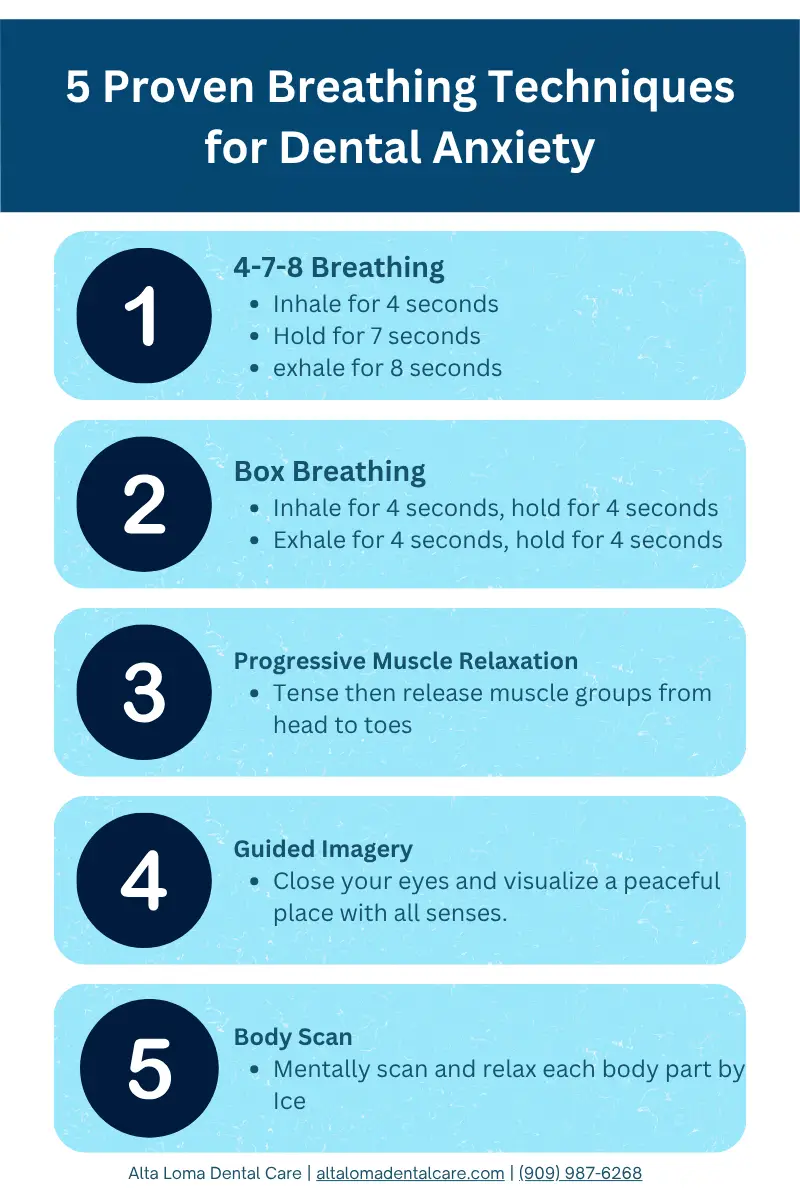
Relaxation techniques, such as deep breathing exercises and progressive muscle relaxation, can help patients calm their minds and body. Taking slow, deep breaths can activate the relaxation response and reduce anxiety.
Try practicing these techniques in the days before your appointment:
- Deep breathing: Breathe in slowly for four counts, hold for four counts, then breathe out for four counts. Repeat this five times.
- Progressive muscle relaxation: Tense one group of muscles (like your hands), hold for a few seconds, then release. Work from your head down to your toes.
- Guided imagery: Close your eyes and picture a calm, safe place — a beach, a forest, your living room. Focus on the details: what do you see, hear, and feel there?
Prepare a Calming Playlist
Prepare a calming playlist or download a meditation app for use during your visit. Music or guided meditations can be powerful tools for managing anxiety during dental procedures.
Bring a Support Person
When you go to dental appointments, bring someone you know and trust who doesn’t share your anxiety. Having a familiar, calm presence in the waiting room can help you feel grounded.
Avoid Caffeine Before Your Visit
Caffeine naturally increases your heart rate and can make anxiety worse. On the morning of your appointment, try herbal tea or water instead of coffee or energy drinks.
During Your Appointment: In-the-Chair Strategies That Work
Once you are in the chair, use these techniques to stay calm and in control.
Speak Up — Always
Remind the dentist and dental staff about your anxiety when you arrive. Share any bad experiences you may have had in the past, and ask for suggestions on coping strategies. Don’t be afraid to ask questions. Sometimes knowing what is going to happen alleviates any fears of the unknown.
Agree on a Stop Signal
Agree on a signal. Let your dentist know by raising your hand if you need to take a break during an exam. This small step gives you control over the situation. Knowing you can pause at any time makes it much easier to start.
Establish clear hand signals or other indicators that allow you to communicate if you need a break or are experiencing discomfort.
Use Breathing to Stay Grounded
Count your breaths. Inhale slowly and then exhale for the same number of counts. Do this five times while you’re waiting for your appointment, or during breaks while you’re sitting in the dental chair.
Do a body scan. Concentrate on relaxing your muscles, one body part at a time. Start with your head and work your way down to your toes.
Use Distraction Tools
Wearing headphones and listening to music during procedures is one of the most effective ways to stay calm in the chair. Bring your own playlist, podcast, or audiobook to keep your mind occupied.
Holding comfort items, like squeezable balls or small stuffed animals, in the dental chair can also help. Offer patients something to do with their hands, like a stress ball or fidget spinner they can use during their appointment and take home with them.
Try Guided Imagery in the Chair
Patients are taught to develop a mental image of a pleasant, tranquil experience — complete with specific, concrete details such as with sound, smell, and colors — that guides their attention to achieve relaxation, thereby reducing anxiety. You can practice this on your own while in the chair. Just close your eyes and return to that calm, safe place you visualized at home.
Request Comfortable Positioning
Request a more vertical positioning of the dental chair if you find the horizontal position intimidating. Small changes like this can make a real difference in how safe and in control you feel.
Clinical Options for Severe Dental Anxiety
If your dental anxiety is strong, lifestyle techniques alone may not be enough. That is completely okay. There are medical and clinical options that can help.
Sedation Dentistry
For more intense anxiety, sedation dentistry may be a helpful option. Mild forms like nitrous oxide (laughing gas) are commonly used to help patients feel calm but awake. Oral sedatives or IV sedation may also be available for those with more severe fear. Don’t hesitate to ask your dentist about sedation options. It’s not a last resort — it’s a legitimate and safe way to manage strong dental anxiety.
At Alta Loma Dental Care, we can discuss which sedation option is right for your level of anxiety. Call us at (909) 987-6268 to learn more about what we offer.
Nitrous Oxide (Laughing Gas)
This is the most common and gentle form of sedation. You breathe in a mixture of nitrous oxide and oxygen through a small mask placed over your nose. It helps you feel relaxed and comfortable while keeping you fully awake and able to communicate. The effects wear off quickly, so you can drive yourself home afterward.
Oral Sedation
This involves taking a prescription medication before your appointment. It makes you feel deeply relaxed — some patients feel drowsy. You will need someone to drive you home after this type of sedation.
Cognitive Behavioral Therapy (CBT)
Psychotherapeutic behavioural strategies can modify the patient’s experience through a minimally invasive approach with nil or negligible side effects, depending on patient characteristics, anxiety level and clinical situations.
CBT is a type of talk therapy that helps you identify and change the thought patterns that drive your anxiety. A licensed therapist can help you work through deep-rooted dental fears over time. Many patients find that a few sessions of CBT combined with dental visits help them build lasting confidence.
Acupuncture and Acupressure
Reports on the use of auricular acupuncture for treating chronic and acute anxiety have shown promising results. A randomized controlled trial comparing auricular acupuncture with intranasal midazolam for managing dental anxiety suggested that both treatment methods were similarly effective.
If you are open to alternative therapies, these options are worth exploring alongside traditional dental care.
After Your Appointment: Reinforce the Positive Experience
What you do after your visit matters just as much as what you do before and during it.
Celebrate Your Win
You did it! Acknowledge that. Managing dental anxiety takes real courage. Reward yourself after your appointment — whether that’s a favorite meal, a walk in the park, or simply resting at home. Positive reinforcement helps your brain connect dental visits with good feelings over time.
Reflect on What Worked
After each appointment, think about which techniques helped you the most. Did the breathing exercises calm you down? Did music make the time go faster? Build on what works and refine what doesn’t.
Schedule Your Next Visit Before You Leave
Over time, consistent dental care is one of the most effective ways to reduce fear. Each positive experience reinforces the idea that the dentist’s office is a safe, manageable place.
Booking your next appointment before you leave the office removes a big mental hurdle. It also helps you keep up with regular care, which means simpler, shorter visits over time.
Keep Up with Home Oral Care
Good oral hygiene between visits means fewer problems to treat — and fewer reasons to worry. Brush twice a day with fluoride toothpaste, floss daily, and rinse with an antibacterial mouthwash. The healthier your mouth stays, the smoother and faster your dental appointments will be.
How Alta Loma Dental Care Supports Anxious Patients
At Alta Loma Dental Care, we understand that managing dental anxiety is a team effort. Our goal is to create an environment where every patient feels heard, respected, and safe.
Here is what you can expect when you visit us:
- Judgment-free conversations — We want to hear about your fears. There is no shame in feeling anxious.
- Clear explanations — We explain every step of a procedure before we begin, so there are no surprises.
- Stop signals — We use a hand-signal system so you are always in control.
- Compassionate pacing — We never rush. If you need a break, we stop.
- Sedation options — We offer solutions for patients with moderate to severe anxiety.
Taking the time to listen is key, especially if patients have experienced a traumatic dental surgery. Our team is trained to lead with empathy and respond to fear with kindness — because that is what you deserve.
We are located at 7283 Carnelian St, Rancho Cucamonga, CA 91701. You can reach us anytime at (909) 987-6268 or visit our website at altalomadentalcare.com.
Quick Reference: Managing Dental Anxiety at a Glance
| When | What to Do |
|---|---|
| Before your visit | Call ahead to tell us about your anxiety, practice deep breathing, prepare a playlist, bring a support person |
| Day of your visit | Avoid caffeine, arrive early, use your breathing techniques in the waiting room |
| During your visit | Use your agreed stop signal, listen to music, do a body scan, use guided imagery |
| After your visit | Celebrate, reflect on what worked, book your next appointment, maintain daily oral care |
Final Thoughts: Your Smile Is Worth It
Managing dental anxiety is a journey, not a single event. But every step you take brings you closer to a healthier, more confident smile. You deserve dental care that feels safe. You deserve a team that listens. And you deserve a visit where you feel in control every step of the way.
At Alta Loma Dental Care, that is exactly what we are committed to providing.
Ready to take the first step? Contact us.
We are here — and we cannot wait to help you smile again.
This article is for educational purposes and is part of our patient resource library at Alta Loma Dental Care. For personal dental advice, please contact our office directly.